
37+ Fun and Engaging Physical Activities for Preschoolers
Physical play plays an important role in a preschool child’s development, especially when it is gently integrated into everyday activities. Through movement, children have opportunities to build physical strength, explore their own abilities, and gradually develop essential life skills in a way that feels enjoyable and age appropriate. At La Petite Ecole Ho Chi Minh City, we believe that regular physical activities can support children’s overall well-being, cognitive growth, and the development of key life skills.
Among the many movement-based activities suitable for preschool-aged children, La Petite Ecole Ho Chi Minh City has curated a list of 20+ fun and engaging play-based learning games for young children designed to spark curiosity and encourage active participation. Let’s explore them together in the article below.
Key Takeways
-
Physical play is an important part of a preschool child’s daily routine, helping children explore their bodies through movement and active experiences.
-
Each child develops at their own pace and shows interest in different types of activities, so physical play should be adjusted flexibly to suit individual needs and family cultural contexts.
-
Movement activities do not need to be complex or require special equipment. Simple games can still encourage children to stay active and interact with others.
-
Even small spaces can support physical play when they are thoughtfully arranged and safety is carefully considered.
-
When encouraged in a supportive way, physical play can naturally contribute to children’s physical well-being, emotional development, and social skills.
-
Adult involvement and observation play an important role in creating a positive and supportive environment for preschool physical activities.
The Benefits of Physical Activities for Preschoolers
1. Physical Development
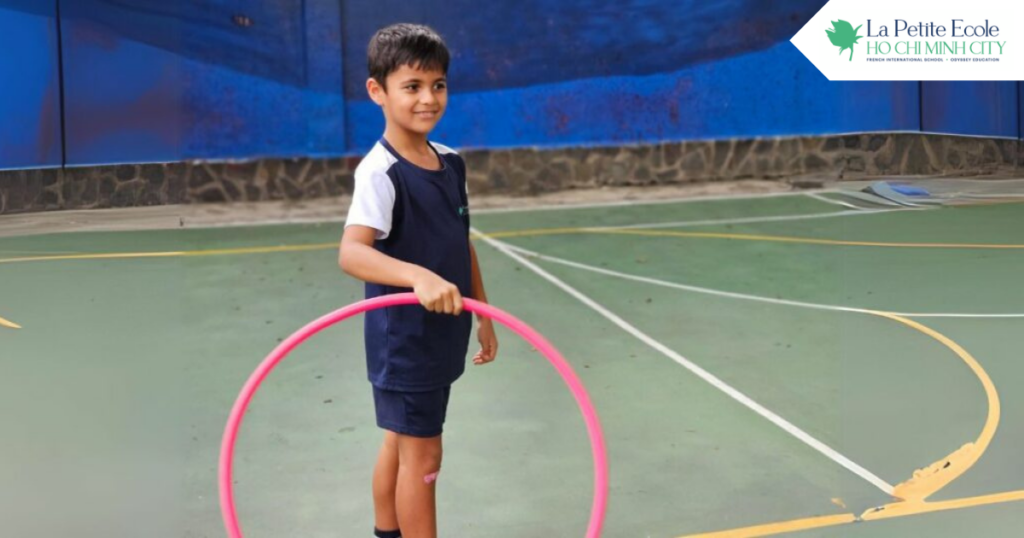
Engaging in regular physical activities for preschoolers is essential for their physical development. These activities help strengthen muscles, improve flexibility and agility, and teach basic motor skills like running, jumping, and hand-eye coordination.
2. Cognitive Development
In addition to physical growth, physical activities play a vital role in brain development. They stimulate neural connections, enhancing memory and cognitive skills. Particularly, creative physical activities encourage logical thinking, problem-solving, and foster a rich imagination in young children.
3. Social Skills Development
Group physical activities also help preschoolers develop essential social skills such as cooperation, sharing, and respecting others. This contributes to building positive character traits from an early age.
4. Promotes Positive Energy
Lastly, physical activities bring joy and allow children to release positive energy. After each session, they feel refreshed, happy, and ready for the next challenge.
Fun and Engaging Physical Activities for Preschoolers Aged 3-4 Years
1. Blindfold game
- Objective: This game not only helps children develop their physical abilities but also their social skills, such as agility, coordination, teamwork, and quick thinking.
- Preparation: A clean, soft cloth to blindfold the player, and a safe play area.
- How to Play:
-
- Decide who will be the ‘it’ by drawing straws or counting
- Tie the cloth securely over the seeker’s eyes.
- When you say ‘go’, the seeker will try to catch the other players. The other players will run and try to trick the seeker by making noises.
- When the seeker catches someone, they switch places and the game continues.
2. Hopping Game
- Objective: This game not only helps children develop physically but also enhances their counting skills and logical thinking.
- Preparation: Use chalk to draw numbered squares on the ground. The number and size of the squares should depend on the available space and the age of the children.
- How to Play:
-
- The children line up neatly at the starting line.
- The first child will throw a beanbag onto any square.
- The child will then hop on one foot across the numbered squares, avoiding stepping on the square with their beanbags.
- Once they reach the end, they will return to the starting position and throw the beanbag onto the next square.
- Any child who breaks the rules (hopping out of the square or stepping on the lines) will be eliminated.
3. Obstacle Course
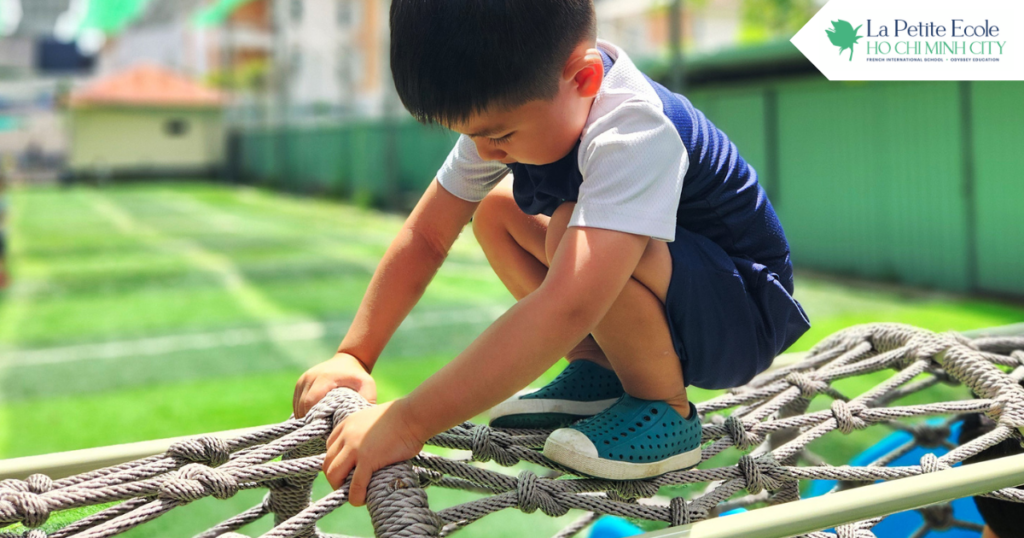
- Objective: The obstacle course is one of the most loved physical activities for preschoolers aged 3-4 years. Aimed at developing agility, coordination, and teamwork, this game not only promotes physical development but also supports overall growth.
- Preparation: Set up age-appropriate obstacles that match the children’s abilities, such as small climbing frames, tunnels, and hula hoops.
- How to Play:
-
- Divide the children into teams of 4-5 players each.
- Have the teams line up neatly at the starting line.
- On the signal, the first child from each team will take turns navigating the arranged obstacles.
- After completing the course, they will run back to the starting line and tag the next player.
- The team that completes the course the fastest and without making mistakes wins.
4. Ball Passing
- Objective: Ball passing is one of the most popular physical activities for preschoolers. This game helps children develop motor skills such as hand-eye coordination, throwing, and catching, while also fostering teamwork and social skills.
- Preparation: Use a soft plastic ball that is appropriate for the size of the children.
- How to Play:
-
- Have the children sit in a circle facing each other. If there are many children, you can divide them into smaller circles.
- On the signal, the children will take turns passing the ball in a designated direction.
- Any child who drops the ball will temporarily leave the game.
- The game ends when only one child remains or when the time limit is reached.
5. Follow the Line
- Objective: Helps children practise balance and develop better control of their movements.
- Preparation: Colored tape or chalk to draw lines on the floor.
- How to play:
-
-
Create straight or curved lines on the floor.
-
Children walk along the line without stepping outside it.
-
The activity can be varied by walking slowly, walking faster, or walking on tiptoes.
-
6. Simon Says
- Objective: Simon Says is a fun game that encourages listening skills and physical activity.
- Preparation: No materials are needed, just a safe area for movement.
- How to Play:
-
- One child (or an adult) is “Simon” and gives commands (e.g., “Simon says jump like a frog” or “Simon says spin in a circle”).
- If the command doesn’t start with “Simon says,” children should not follow it. This helps develop listening and attention skills.
7. Ants Carrying Food
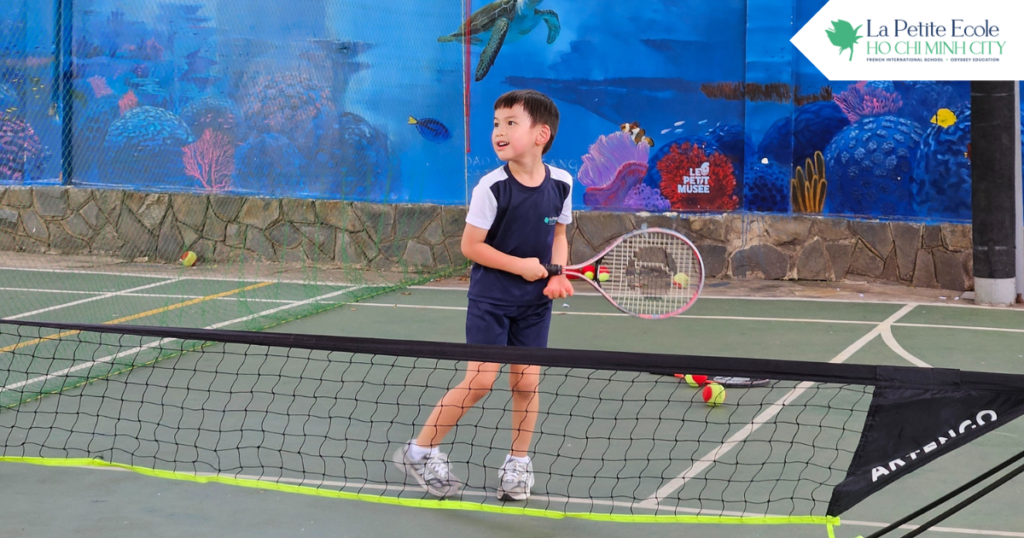
- Objective: Encourages movement while supporting memory and quick responses.
- Preparation: Small objects to represent the “food”.
- How to play:
-
-
Children run to collect an object and carry it back to the “nest” when given a signal.
-
Each child carries only one object at a time.
-
The game is light, playful, and full of energy.
-
8. Jumping Over Objects
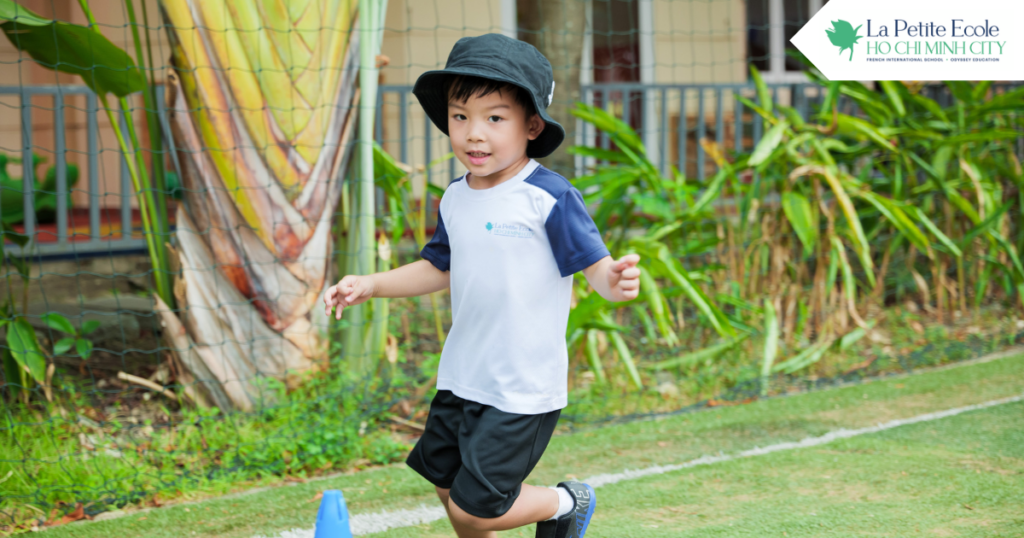
- Objective: Jumping over objects is a simple yet highly effective physical activity for preschoolers, especially for children aged 3-4 years. This game not only helps develop basic motor skills such as walking, standing, and jumping but also improves balance and boosts confidence.
- Preparation: Prepare around 5-6 soft objects of varying sizes, such as foam cushions, small soft toys, etc. Ensure the area is safe and free from hazards.
- How to Play:
-
- Arrange the objects in a straight line with a reasonable distance between them.
- Place the child’s favorite toy at the end of the line.
- On the signal, the child will begin jumping over the objects to retrieve the toy.
9. Fruit Picking
- Objective: Fruit Picking is an exciting and beneficial physical activity. This game not only gets children moving but also helps them develop color recognition and teamwork skills.
- Preparation: Set up a model tree with a variety of brightly colored fruits, along with baskets or containers for collecting the fruits.
- How to Play:
-
- Divide the children into teams of 3-4 players each.
- The teacher will instruct each team to pick a specific type of fruit with a designated colour.
- On the signal, team members will take turns running to pick the fruit and bring it back to their team.
- The team that collects the required number of fruits first wins.
10. Dance and Freeze
- Objective: Jump and Freeze is one of the most popular physical activities for preschoolers, especially for children aged 3 and above. This game helps develop coordination between hands and feet while enhancing rhythm and concentration.
- Preparation: A music player.
- How to Play:
-
- When signaled, the teacher will play music.
- The children will dance freely and creatively to the rhythm of the music.
- When the music suddenly stops, they must freeze in place and hold their position.
11. The Train
- Objective: The Train Game is an engaging and beneficial physical activity for preschoolers. This activity helps children develop listening skills, body coordination, and creativity.
- How to Play:
-
- The teacher will take on the role of the train driver and give commands.
- Green Light: The entire train starts moving while making a cheerful “Choo-choo” sound.
- Going Uphill: The train slows down, and the children walk on their heels, creating the sound “Toot-toot.”
- Going Downhill: The train speeds up, and the children walk on their toes while continuing to make the “Toot-toot” sound.
- Through the Tunnel: The children will bend down to form a tunnel shape.
- Stop: The whole train comes to a stop.
- After each round, roles can be switched, allowing the train driver to become a member of the train and vice versa.
- The teacher will take on the role of the train driver and give commands.
12. Leaves and Wind Game
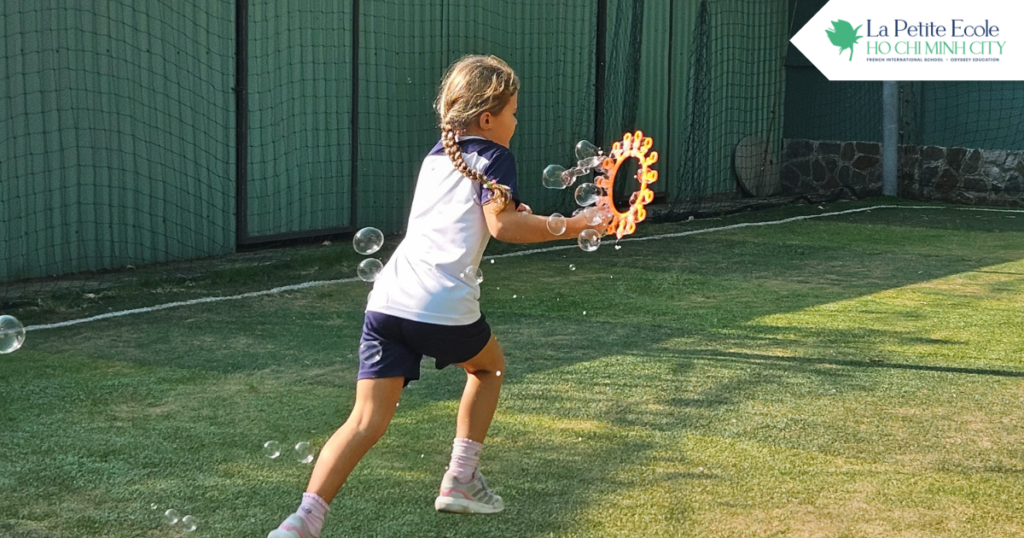
- Objective: This is another fun and valuable physical activity for kids. The game helps children enhance their listening skills, body coordination, and imaginative play.
- How to Play:
-
- The children will transform into beautiful leaves.
- The teacher will act as the wind and give commands such as:
- Gentle Breeze: The children will sway gently like leaves in the wind.
- Strong Wind: The children will run quickly and skip about like leaves being blown by a strong gust.
- Wind Stops: The children will freeze in place, becoming leaves that fall to the ground.
- The teacher will vary the intensity of the “wind” unexpectedly to make the game even more exciting.
13. Balance Bike Race
- Objective: Supports the development of leg strength, balance, and coordination while moving.
- Preparation: Balance bikes suitable for children’s height, along with a wide and flat outdoor space.
- How to play:
-
Set up a short, safe race track.
-
When given a signal, children use their feet to push the bike toward the finish line.
-
The activity is relaxed and pressure-free, with no focus on speed.
-
14. Tug of War
- Objective: Encourages the development of arm and leg strength, as well as coordination when working in a group.
- Preparation: A soft but sturdy rope and an open space.
- How to play:
-
-
Divide the children into two groups with a similar number of players.
-
When given a signal, both teams pull the rope toward their side.
-
The rules can be adjusted to ensure safety and a positive, playful atmosphere.
-
15. Fun Basketball Game
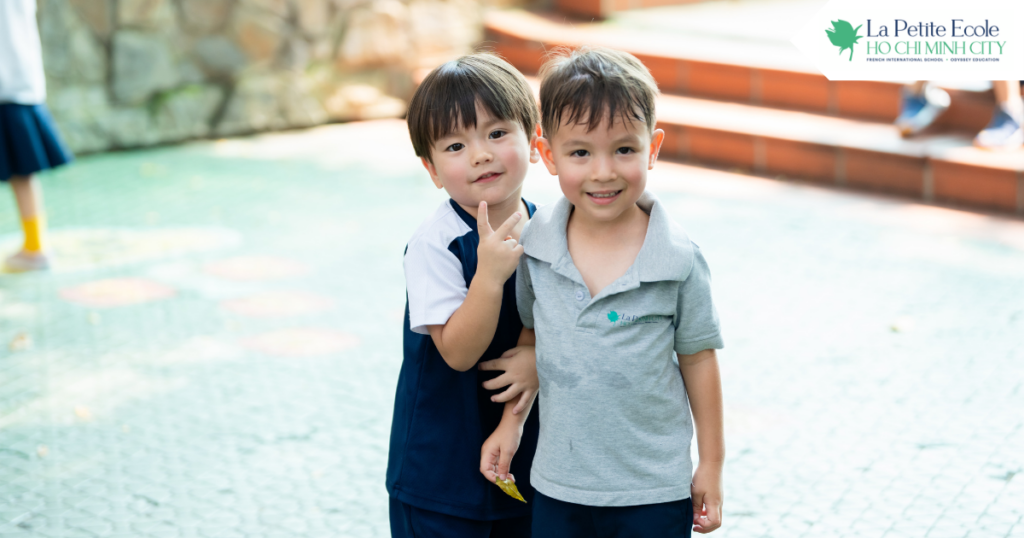
- Objective: Helps preschool children practice hand–eye coordination, improve flexibility, and become familiar with throwing movements.
- Preparation: Soft balls and a low basketball hoop or a plastic container.
- How to play:
-
-
Place the hoop or container at a height suitable for the children.
-
Children take turns throwing the ball into the hoop from a short distance.
-
The throwing position can be changed to keep the activity engaging and fun.
-
Fun and Engaging Physical Activities for Preschoolers Aged 5-6
1. Relay Race
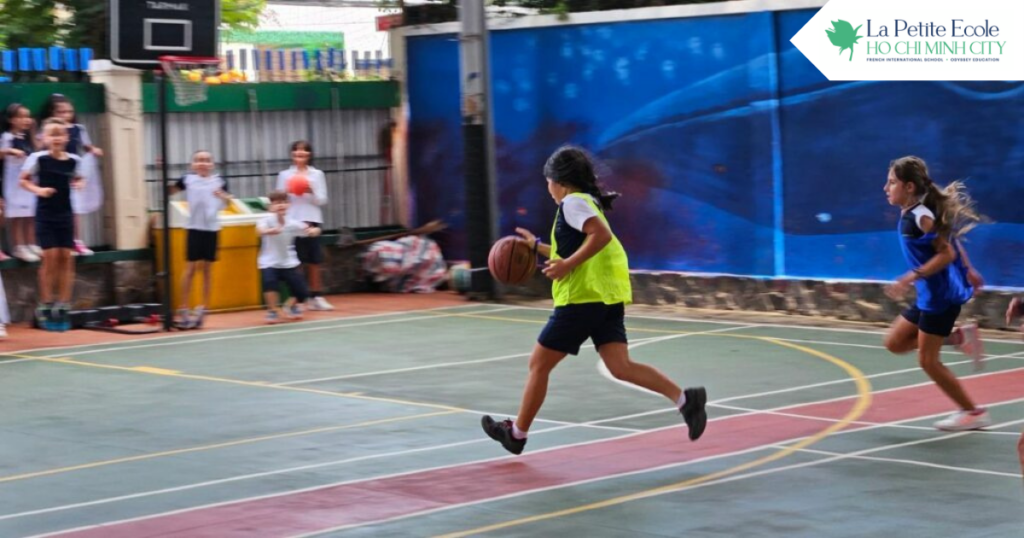
- Objective: The Relay Race is one of the most popular outdoor physical activities for preschoolers, especially for children aged 5-6. This game not only helps children build endurance and improve their health but also fosters teamwork and coordination skills.
- Preparation: Use balls, flags, or other objects to create obstacles that add excitement to the game.
- How to Play:
-
- Divide the children into teams of about 4-5 players each.
- Clearly define the starting and finishing lines for each team.
- Set up obstacles (if using) along the running path to increase the challenge.
- At the signal, the first member of each team will run to the obstacle, circle it, and return to touch the hand of the next teammate. The team that finishes first without making mistakes wins.
2. Sack Race
- Objective: This game helps children develop agility and coordination while also promoting health and teamwork.
- Preparation: Provide sacks for the children to jump in.
- How to Play:
- Divide the children into teams with an equal number of members.
- Clearly define the starting and finishing lines for each team.
- On the signal, the first member of each team will step into their sack and jump towards the finish line. Once they reach the finish, they will exit the sack and pass it to the next player.
- The team that finishes first without making errors wins.
3. Three-Legged Race
- Objective: The Three-Legged Race is an incredibly fun physical activity for preschoolers aged 5-6. This game not only helps children develop agility and coordination but also fosters teamwork and strengthens their connections with friends.
- Preparation: Use straps or soft ties to bind legs together.
- How to Play:
-
- Pair the children up.
- Tie one child’s right leg to their partner’s left leg using the straps.
- Clearly define the starting and finishing lines for each pair.
- At the signal, the pairs will move together towards the finish line. The pair that reaches the finish first without dropping the straps wins.
4. Ring Toss
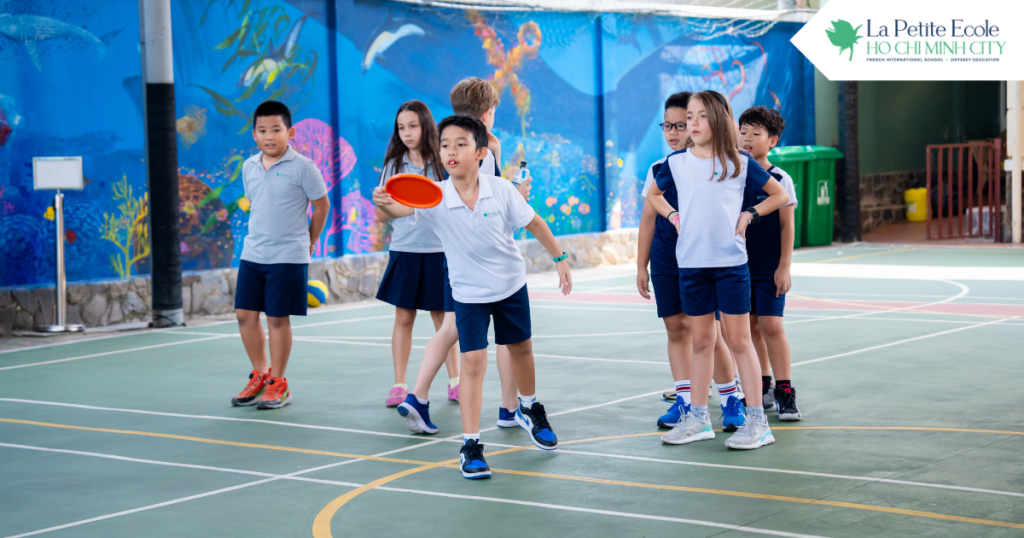
- Objective: Ring Toss is a simple and enjoyable physical activity suitable for preschoolers. This game helps children enhance their hand-eye coordination, improve focus, and effectively develop fine motor skills.
- Preparation: Use a pre-made ring toss set or create your own at home using paper rings, cardboard, and plastic bottles.
- How to Play:
-
- Set up plastic bottles or other targets at a distance appropriate for the children’s abilities.
- Children hold the rings and try to throw them onto the targets.
- Each successful ring toss that lands on a target earns points. The child with the highest score wins.
5. Statue Game
- Objective: This game helps children improve their reflexes, body coordination, and enhances concentration while promoting flexible thinking.
- Preparation: Use a music player with cheerful songs.
- How to Play:
-
- Play some music and encourage the children to dance along.
- Suddenly stop the music and ask the children to freeze in place like statues.
- Any child who moves will be out of the game.
- Continue playing until only one child remains.
6. Land Canoeing
- Objective: Land Canoeing is a highly engaging group physical activity for preschoolers that helps children develop a range of essential skills. This game requires coordinated teamwork among participants, while also enhancing muscle strength and promoting a sense of camaraderie.
- How to Play:
-
- Divide the children into teams, each consisting of about 5-7 members.
- The players in each team sit in a line, with their legs wrapped around the waist of the person in front, forming the shape of a canoe.
- At the signal, the “canoes” will work together using their arms and body strength to move forward.
- The first team to reach the finish line wins.
7. Cookie Jar Game
- Objective: The game encourages listening skills, teamwork, and physical activity.
- Preparation:
-
- Have a group of children sit in a circle.
- Designate one child to be the “Cookie Monster” or “Cookie Keeper.” This child will stand in the middle of the circle.
- How to Play:
-
- The children sitting in the circle can chant together, “Who stole the cookies from the cookie jar?”
- The Cookie Monster then asks one child in the circle, “(Child’s name), how could you steal cookies from the cookie jar?”
- The chosen child responds with a fun or silly answer (e.g., “I tiptoed in!”).
- The Cookie Monster then tries to catch the child as they run around the circle back to their spot.
- If the Cookie Monster catches the child, they switch places. If not, the game continues with the next child.
8. Cat and Mouse
- Objective: The Cat and Mouse game enhances children’s running skills, quick reflexes, social abilities, and overall agility.
- How to Play:
-
- Select two children to play the roles of the cat and the mouse, while the others form a circle holding hands.
- At the signal, everyone sings together, and the cat tries to catch the mouse.
- The mouse will run through the gaps in the circle to evade the cat, who must try to tag the mouse.
- When the song ends, if the cat catches the mouse, the cat wins; otherwise, the mouse is the winner.
9. Hide and Seek
- Objective: Hide and Seek is a fun physical activity for preschoolers that not only improves their movement skills and agility but also helps them develop their thinking abilities, observation skills, and counting practice.
- How to Play:
-
- One child is chosen as the seeker, while the others hide.
- The seeker covers their eyes and counts to a set number (for example, 20), giving the other players time to hide.
- Once the counting is finished, the seeker opens their eyes and begins searching for the hidden players.
- The first player caught becomes the seeker in the next round.
10. Musical Chairs
- Objective: Musical Chairs is a great game for building quick reflexes, enhancing hand-eye coordination, and increasing focus in young children.
- Preparation: Arrange chairs, ensuring there is one fewer chair than the number of players.
- How to Play:
-
- Set the chairs in a circle.
- Play some lively music and have the children walk or dance around the chairs.
- When the music stops, everyone must quickly find a chair to sit on.
- The child who doesn’t find a chair is eliminated.
- Continue playing, removing one chair each round, until only one child is left as the winner.
11. Who’s Faster?
- Objective: This game promotes endurance, coordination of muscle groups, and fosters agility and healthy competition among preschoolers.
- Preparation: Set up obstacles like chairs, boxes, balls, slides, tunnels, hoops, climbing frames, or other objects to create a challenging obstacle course.
- How to Play:
-
- Arrange the obstacles in a sequence to form a racecourse.
- At the signal, the children start racing through the obstacles.
- The child who completes the course the fastest wins.
12. Jump by Color
- Objective: Encourages full-body movement while supporting color recognition and quick reactions.
- Preparation: Colored mats or hoops placed on the floor.
- How to play:
-
-
An adult calls out a color.
-
Children quickly jump to the spot with the matching color.
-
The pace can be varied to keep the activity engaging.
-
13. Crawl Through the Fabric Tunnel
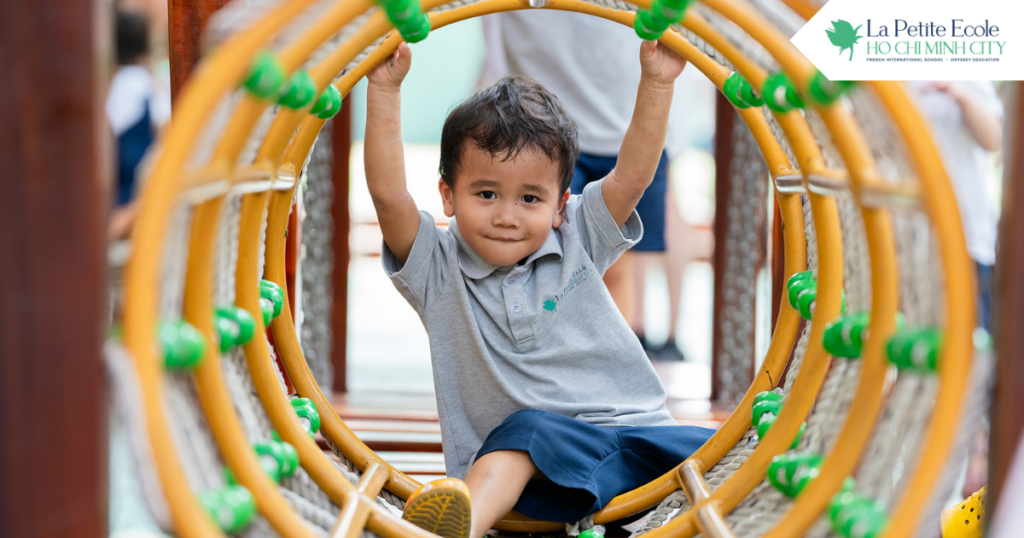
- Objective: Supports the development of arm and leg strength, as well as spatial awareness.
- Preparation: A fabric tunnel or chairs covered with cloth to create a crawling pathway.
- How to play:
-
-
Children crawl through the tunnel from one end to the other.
-
Encourage slow, careful movement to ensure safety.
-
14. Pull the Object to the Finish
- Objective: Helps build arm strength and improve coordination during movement.
- Preparation: A rope and a lightweight object tied to one end.
- How to play:
-
-
Children pull the rope to bring the object toward themselves.
-
The activity can be done individually or in small groups.
-
15. Knock Down the Targets
- Objective: Strengthens arm muscles while supporting distance awareness and hand–eye coordination.
- Preparation:
-
-
Three to five empty cans or lightweight plastic bottles.
-
A soft ball sized appropriately for children’s hands.
-
- How to play:
-
Arrange the cans or bottles in a small group or stack at a fixed spot.
-
Children stand at a marked throwing line.
-
Each child takes turns throwing the ball to knock down the targets.
-
The game can be repeated for several rounds so all children have a chance to participate.
-
Other Outdoor Group Physical Activities for Preschool Children
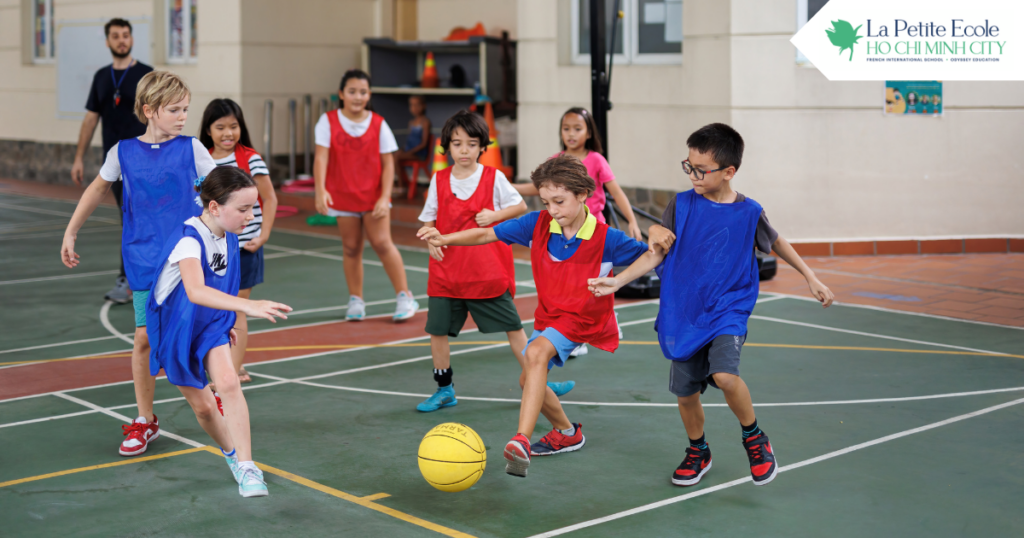
The activities below are inspired by common physical play ideas for preschool children. They focus on natural movement, outdoor play, and opportunities for children to release energy through active participation.
- Passing Water with Cups: Children work in groups to pass water from one cup to another, combining hand movement with group coordination.
- Passing Objects Overhead: Children stand in a line and pass a lightweight object over their heads to the child behind them, creating a steady rhythm of movement and encouraging teamwork.
- Following Footprints: The group moves together by stepping on prepared footprints placed on the ground, supporting movement and visual attention.
- Moving in Different Ways: Children try walking on their heels, on tiptoes, or taking long steps, helping their bodies experience different movement patterns.
- Flag Relay Run: Teams take turns running to collect a flag and bring it back to the starting point, encouraging active movement and cooperation.
- Overhead Ball Passing: Children stand in a line and pass a ball over their heads to the next person, combining arm movement with group coordination.
- Collecting Objects Together: The group moves around to collect and sort objects within the play area, combining physical activity with collaborative play.
Notes When Organizing Physical Games for Preschool Children
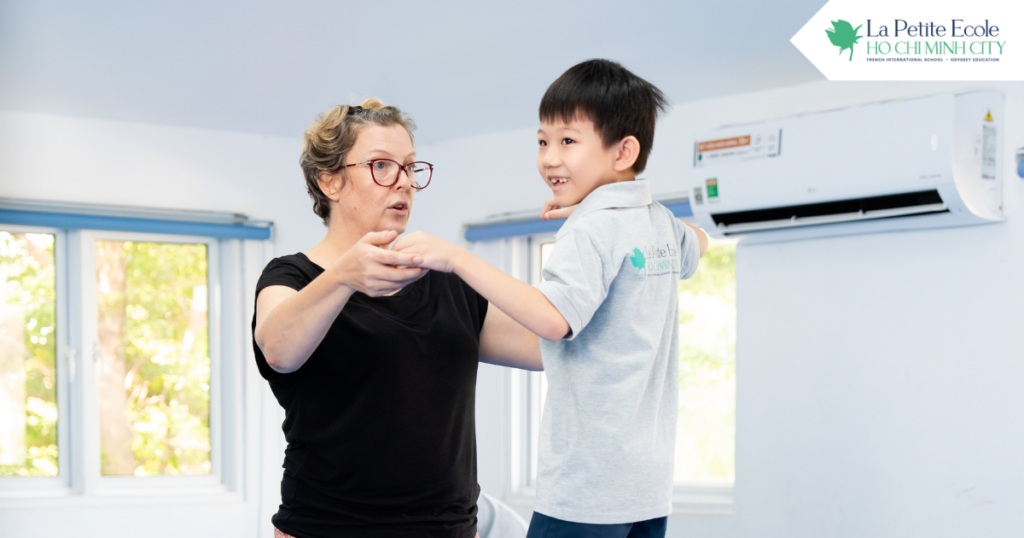
When organizing physical activities for preschool children, adults should observe and adjust activities to suit each group, rather than applying a fixed approach.
-
Choose activities that match children’s age, physical abilities, and confidence levels, avoiding a one-size-fits-all approach.
-
Prepare a safe and tidy play space, limiting sharp objects or slippery surfaces.
-
Prioritize simple, lightweight, and easy-to-use equipment so children can move comfortably.
-
Plan playtime with a balanced duration, alternating active games with quieter activities to prevent overexertion.
-
Encourage participation in a positive and relaxed way, without comparison or pressure.
-
Adjust activities flexibly to suit classroom spaces, outdoor areas, or home environments.
-
Observe children’s responses closely and adapt activities when needed to ensure physical play remains a positive experience.
La Petite Ecole Ho Chi Minh: Nurturing Your Child's Physical Development
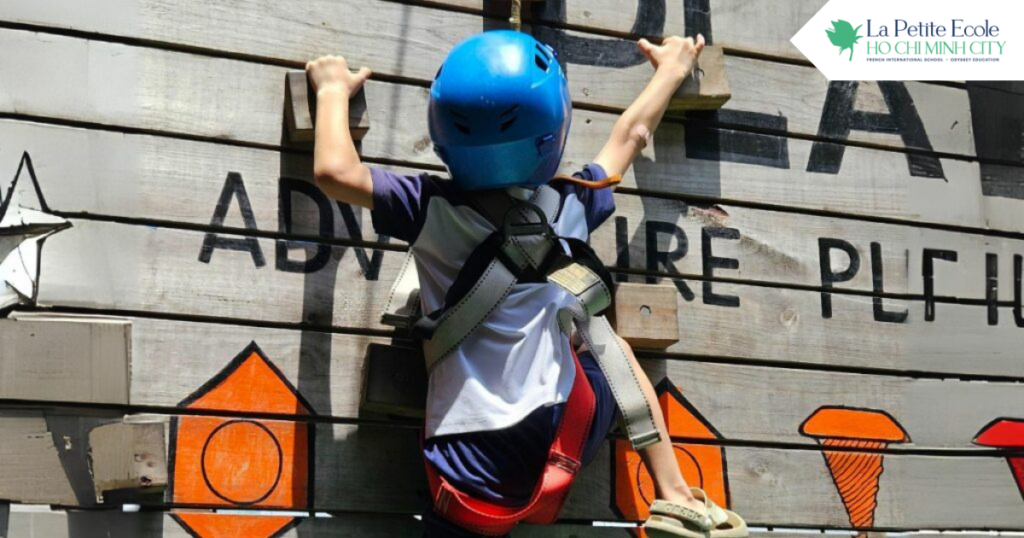
At La Petite Ecole International Bilingual School in Ho Chi Minh City, we believe that physical development is one of the most important aspects of a child’s growth. With our modern learning environment, comprehensive curriculum, and experienced teachers, we not only focus on academic excellence but also on providing ample opportunities for children to engage in physical activities, exploration, and overall development. Physical activities are integrated into our daily curriculum, helping children build strength, improve fitness, and develop essential life skills.
We hope this information has provided parents with a better understanding of the importance of physical activities for preschoolers. If you have any questions, please don’t hesitate to contact La Petite Ecole Ho Chi Minh today for more information about our educational programs.
- Phone: 028 3519 1521
- Email: contact@lpehochiminh.com
- Address: 172 – 180 Nguyen Van Huong, An Khanh Ward, Ho Chi Minh City
Frequently Asked Questions About Physical Games for Preschool Children
1. What are physical games for preschool children?
Physical games for preschool children are activities that involve movement such as running, jumping, crawling, climbing, throwing, or balancing. These activities give children opportunities to explore their physical abilities naturally through everyday play.
2. How long should preschool children take part in physical activities each day?
The appropriate amount of physical activity can vary depending on a child’s age, physical condition, and daily routine. Many families and schools choose shorter activity periods spread throughout the day so children remain comfortable and engaged.
3. Are physical games suitable for children who are less active?
Some children need more time to feel comfortable with physical activity. Starting with simple, slow-paced, and non-competitive games can help children feel secure and gradually build confidence in joining in.
4. Can physical games be organized in small spaces?
Yes. Many gentle movement activities such as following a line, balancing, passing a ball, or moving to music can be adapted for classrooms or home environments, as long as the play area is tidy and safe.
5. What benefits do physical games offer preschool children?
Physical games support physical development, coordination, and spatial awareness. In addition, these activities encourage communication, cooperation, and positive emotional expression.
6. How can safety be ensured during physical games?
Adults should closely observe children, choose activities that match their age and abilities, and check the play space before starting. Adjusting activities flexibly for different groups of children is also important.