

French Primary School in Vietnam: Curriculum, Ages and Admissions Explained
A French primary school is a school that delivers the French national curriculum to children aged 6 to 11, across five year groups known as CP, CE1, CE2, CM1 and CM2. Outside France, these schools are accredited by the French Ministry of Education through the AEFE network, which means a child can move between any two schools in the network and continue the same programme without repeating a year. In Vietnam, families will find French primary schools in Ho Chi Minh City, Hanoi and Da Nang, most of them offering a bilingual or multilingual programme alongside the French core. In this article, we will delve into the French primary school system in Vietnam which La Petite Ecole Ho Chi Minh is part of. We will provide an overview of the French education system, explore the subjects and experiences that children encounter in these schools, and shed light on the unique features that come with enrolling in a French primary school in Vietnam.
Key takeaways
- A French primary school covers ages 6 to 11 in five grades: CP, CE1, CE2, CM1 and CM2.
- The French system groups years into three-year cycles rather than judging each year in isolation.
- AEFE accreditation is granted by the French Ministry of Education and makes a child’s school record transferable across 500 or more schools worldwide.
- French primary schools in Vietnam are concentrated in Ho Chi Minh City, Hanoi and Da Nang.
- Most children arrive without fluent French. Schools in the network run language support so that many children reach class level within the first year.
- At La Petite Ecole Ho Chi Minh City, the French curriculum is delivered in French and English in equal parts, with Vietnamese running alongside.
What Is a French Primary School?
French primary school, or école élémentaire, is the stage that follows kindergarten and runs for five years. It is built around a national framework called the socle commun de connaissances, de compétences et de culture, which sets out what every child should know and be able to do by the end of each cycle. The framework is set by the French Ministry of Education and is identical whether the school sits in Lyon, Dakar or Ho Chi Minh City.
What makes a school abroad part of this system is homologation, the accreditation granted by the French Ministry of Education and coordinated by the AEFE, the Agency for French Education Abroad. The AEFE network covers more than 500 schools across roughly 140 countries. Accreditation is reviewed periodically and can be granted stage by stage, so it is worth checking that a school is accredited for the primary years specifically and not only for kindergarten. You can read more about how this works on our French education overseas page.
Two features tend to surprise families arriving from a British or American system. The first is the cycle structure: skills are assessed across three years rather than at the end of each one, which gives many children room to consolidate at their own pace. The second is that a French primary school abroad is rarely French only. Most schools in Vietnam run a bilingual programme, and it helps to understand what a bilingual school actually commits to before comparing options.
Overview Of The French Education System
The French education system is renowned for its rigor and comprehensive curriculum. In Vietnam, French primary schools follow this system closely, providing students with a strong academic foundation.
Age and Grade Divisions
The French curriculum is organised in learning cycles of 3 years, at the end of which students have to validate acquired skills of the official French Curriculum. Year of birth of children defines the class level as follows:
Kindergarten (Early Years school):
- École Maternelle is the Early Years stage of the French education system, designed for children aged 3 to 6.
- It consists of three divisions: Petite Section (PS) for 3 to 4-year-olds, Moyenne Section (MS) for 4 to 5-year-olds, and Grande Section (GS) for 5 to 6-year-olds.
- The primary focus here is on early childhood education, socialization, and preparing children for primary school, through a play-based approach.
- At the end of École Maternelle, students will complete cycle 1, which is the cycle of the first learnings.
Primary School:
- École Élémentaire is the primary school stage, catering to students aged 6 to 11.
- It comprises five grades: Cours Préparatoire (CP) for 6 to 7-year-olds, Cours Élémentaire 1 (CE1) for 7 to 8-year-olds, Cours Élémentaire 2 (CE2) for 8 to 9-year-olds, Cours Moyen 1 (CM1) for 9 to 10-year-olds, and Cours Moyen 2 (CM2) for 10 to 11-year-olds.
- The end of CE2 marks the end of cycle 2, the cycle of fundamental learnings. Cycle 3 overlaps CM1 and CM2 plus the first year of middle school to reinforce cooperation between primary school and secondary school.
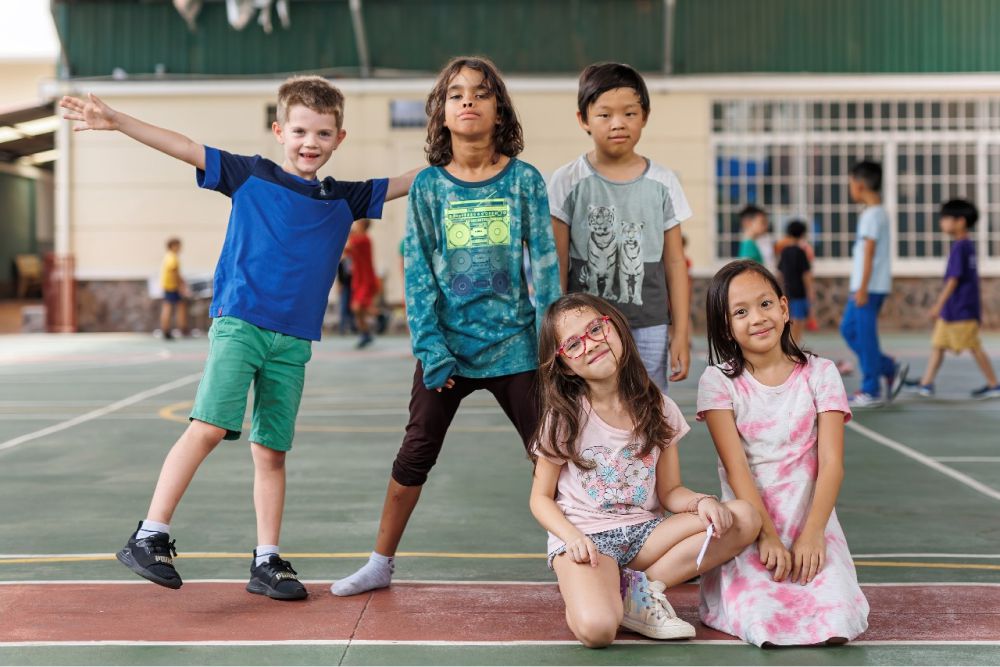
French Grade Equivalents in Vietnam, the UK and the US
Families comparing schools mid-move usually want to know which year their child lands in. This table sets the French grades against the systems parents in Vietnam most often compare them with. Placement is by year of birth rather than by date of arrival, so a child does not lose or gain a year by moving in October.
| French grade | Age | Cycle | Vietnam (MOET) | England | United States |
|---|---|---|---|---|---|
| CP | 6 to 7 | Cycle 2 | Lớp 1 | Year 2 | Grade 1 |
| CE1 | 7 to 8 | Cycle 2 | Lớp 2 | Year 3 | Grade 2 |
| CE2 | 8 to 9 | Cycle 2 | Lớp 3 | Year 4 | Grade 3 |
| CM1 | 9 to 10 | Cycle 3 | Lớp 4 | Year 5 | Grade 4 |
| CM2 | 10 to 11 | Cycle 3 | Lớp 5 | Year 6 | Grade 5 |
Equivalences are indicative. Schools confirm placement after reviewing the child’s school record and date of birth.
The Journey from “nursery school” to “elementary school”
Early Years School is an essential step of the students’ path to drive them to their school success. Its main objective is to motivate and give willingness to children to attend school in order to learn, confirm and fulfill their personality. Early Years School is the language school, which is aimed at helping students to progress, from “petite section” to “grande section”, towards the comprehension and the usage of an oral French and/or English language increasingly elaborated, and on which they will be able to rely on during reading learning. Project-based learning is offered all year round in order to support vocabulary and sentence’s structure learnings. Thus allowing a greater ease in language, useful to start reading.
Early Years School is a school where children will learn together and live together. They will develop their oral language and start to discover writings, numbers, and other learning areas: exploring the world, acting, expressing oneself, and understanding through artistic and physical activities. They learn through games, thinking by resolving problems, practicing, remembering, and memorising.
Primary School is the extension of Early Years School and consists of two learning cycles, aimed at developing skills in 5 areas:
- languages, to think and communicate
- methods and tools for learning
- educating the person and the citizen
- natural and technical systems
- representation of the world and human activity
Focus is still on language to provide students the capacity to understand and speak, read, write and understand the language function.
The step from Grande Section into CP is the one families ask about most. Kindergarten is play-led and oral; CP is the year formal reading begins. Many children find the change of rhythm bigger than the change of content, which is why the transition is planned across the two years rather than over a summer. Our guide on how to get ready for first grade sets out the skills that matter most in the months before CP, and our Early Years page covers the kindergarten stage in detail.
What do Kids Learn in French Primary Schools in Vietnam
Core Subjects
In a French primary school, the core subjects encompass a broad range of fundamental disciplines. These subjects are designed to provide students with a well-rounded education and a strong foundation for their academic journey. At La Petite Ecole, each subject is taught in French and in English, as part of the multilingual program. The core subjects in a French primary school typically include:
- Language:
- Language and literature are central components of the curriculum. Students learn grammar, spelling, reading comprehension, and writing skills.
- At La Petite Ecole, as part of the multilingual curriculum, language classes will be both in French, English and Vietnamese.
- Mathematics:
- Mathematics is a fundamental subject where students learn the following skills: collect, design, represent, think, calculate, and communicate. As students advance through grade levels, the complexity increases.
- Questioning the world and Science:
- Questioning the world (in cycle 2) and Science education (in cycle 3) covers topics like biology, chemistry, and physics in an age-appropriate manner. Students explore the natural world, conduct experiments, and develop scientific inquiry skills.
- History and Geography (starting Cycle 3):
- History lessons introduce students to historical events, figures, and the chronology of civilizations. Geography focuses on understanding the world’s geography, countries, cultures, and physical landscapes.
- Physical Education:
- Physical education promotes physical fitness, coordination, teamwork, and a healthy lifestyle through sports and activities.
- Civics and Moral Education:
- Civics and moral education instill values, ethics, and citizenship responsibilities among students.
- Technology and Computer Science:
- The primary school introduces basic technology and computer science concepts to familiarize students with digital skills.
These core subjects provide a comprehensive educational experience, fostering intellectual, creative, and physical development in primary school students. The curriculum is structured to gradually build knowledge and skills in each subject as students progress through different grade levels.
What a School Day Actually Looks Like
At La Petite Ecole Ho Chi Minh City, children in the elementary years alternate between French and English instruction each half day. That structure matters more than a subject list: it means a child is not sitting in a French lesson inside an otherwise English school, but working through mathematics, science and the arts in both languages across the week. Our elementary programme page sets out how the timetable is built, and the French English bilingual school page explains how the two languages are balanced year by year.
Literacy work carries the heaviest weight in CP and CE1. Children decode, then read for meaning, then write. Parents who want to support this at home will find our notes on reading comprehension and on grammar for elementary students useful, since both explain what the school is working on and where home practice helps rather than duplicates.
Beyond the timetable, the school day is bracketed by extra-curricular activities, and the year follows the French calendar of six or seven week term blocks separated by holidays, published in full on our school calendar page. Families moving from a Vietnamese or British school often find this rhythm the most practical difference to plan around.
Cultural and Artistic Subjects
In a French primary school, cultural and artistic subjects hold a special place in the curriculum, nurturing creativity and cultural appreciation among young learners.
These subjects encompass a wide array of artistic expressions and cultural explorations. Art classes encourage students to unleash their artistic potential through drawing, painting, and sculpture, fostering self-expression and imagination. Music lessons introduce students to the world of melody and rhythm, where they not only learn musical theory but also engage in singing and playing instruments, enriching their auditory and creative senses.
Together, these subjects provide students with a profound understanding of the arts and culture, fostering an appreciation for artistic expression and cultural diversity from an early age. This holistic approach to education in French primary schools encourages students to explore their creative talents and develop a deep respect for the arts and culture..
In the French curriculum this area has a formal name, éducation artistique et culturelle, and a defined expectation: by the end of primary school a child should be able to describe a work of art, place it roughly in time, and talk about why it was made. In Vietnam that plays out locally as well as globally. Classes visit museums and heritage sites in Ho Chi Minh City, work with Vietnamese festivals through the year, and read French and Vietnamese stories side by side. Many children finish primary school able to move between two cultural references without treating either as foreign.
Where to Find French Primary Schools in Vietnam
French curriculum schools in Vietnam are concentrated in three cities, and the options narrow quickly outside them.
- Ho Chi Minh City has the widest choice, most of it in Thao Dien and the surrounding area of Thu Duc City, which is where the majority of French-speaking families live. Schools here range from small human-scale primaries through to a full lycée running to the Baccalauréat.
- Hanoi has an established French school presence covering kindergarten through to secondary, including nursery and kindergarten provision for younger children.
- Da Nang has a smaller French-curriculum offer, generally covering the early and primary years rather than the full secondary path.
- Elsewhere in Vietnam, including cities such as Vinh, Hue and Can Tho, there is currently no accredited French primary school. Families in those areas usually either relocate for schooling or use CNED, the French state distance-learning service, which is recognised within the French system and can be combined with a local school.
La Petite Ecole Ho Chi Minh City sits in Thao Dien and covers nursery through to CM2, the final year of primary school, on one campus. Full details of the programme are on our elementary programme page.
How Much Does a French Primary School Cost in Vietnam?
Tuition at French curriculum schools in Vietnam is set annually and published by each school. Fees vary by year group, so the figure for CP is not the figure for CM2, and the total a family pays depends on several items beyond tuition itself.
What is usually charged separately:
- A one-off registration or enrolment fee
- School bus, where the family uses it
- Lunch and canteen
- Uniform, where the school has one
- Some optional after-school activities and holiday camps
There is one form of support specific to the French system. Families of French nationality resident in Vietnam can apply for an AEFE scholarship through the Consulate General of France, which can be applied against tuition, school meals or transport. It is applied for annually rather than renewed automatically, and the main application window closes in February or March for the following school year, with a second window in October for new arrivals. The current fee schedule and the full scholarship conditions are on our scholarship and tuition fees page.
Unique Points when Enrolling in a French Primary School in Vietnam
Rich Cultural Exposure
French primary schools provide students with a diverse cultural experience through a well-structured curriculum that emphasizes cultural studies, artistic expression, and language acquisition. Students engage with a variety of cultural activities and artistic subjects, including music and visual arts, promoting creativity and self-expression. Language classes not only focus on communication but also on exposing students to the linguistic richness of different languages. Field trips and extracurricular activities often involve visits to museums, historical sites, and cultural events, broadening students’ cultural awareness. This holistic approach ensures that students develop a comprehensive understanding and appreciation of different cultures, nurturing a global perspective.
Diverse Community
French primary schools in Vietnam offer a diverse and inclusive environment for students but also for parents and teachers. These schools often attract a mix of Vietnamese students and expatriates from various backgrounds, creating a multicultural atmosphere. This diversity not only enriches students’ social experiences but also fosters an understanding and appreciation of different cultures. Children have the opportunity to learn from their peers, share unique traditions, and develop a global outlook from an early age. This inclusive community encourages openness, tolerance, and a sense of unity among students, promoting a well-rounded and culturally aware education.
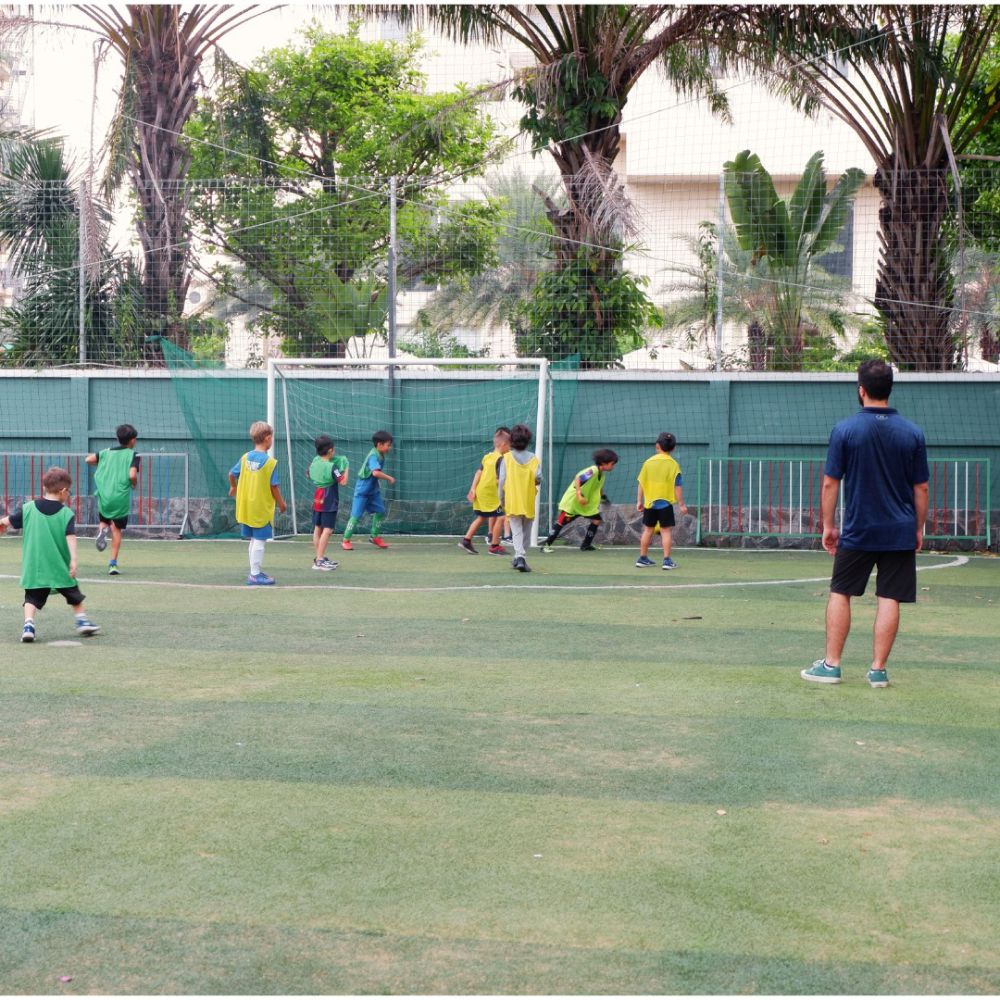
A Genuinely Multilingual Childhood
The point that separates a French school in Vietnam from a French school in France is the third language. Children here grow up with French as the academic backbone, English as a full working language rather than a subject, and Vietnamese as the language of the country they live in. Families often ask whether three languages at once is too many. For many children it is not, provided each language has a clear place and a consistent adult attached to it. Our notes on raising a multilingual child and on how to raise a bilingual child go into what that looks like at home.
From Our Classrooms
One pattern our elementary teachers see every year: a child who arrives in CE1 with no French spends the first term listening far more than speaking. Parents often read that silence as a sign the placement is not working. In most cases it is the opposite. Somewhere around the second or third month the same children begin correcting their classmates’ French in the playground, usually before they will risk a full sentence in class. We now tell families about this pattern at enrolment, because knowing it is coming makes the first term considerably easier on everyone.
What Happens After CM2?
Primary school ends at CM2, around age 11, and children move into collège, the French middle school. Because CM1, CM2 and the first year of collège sit inside the same cycle 3, the handover is designed as a continuation rather than a break, with primary and secondary staff working to a shared set of expectations.
In Vietnam this usually means moving from a primary-only school to a lycée that runs through to the Baccalauréat. Children take the brevet at the end of collège and the Baccalauréat at 17 or 18, which is recognised for university entry in France through Parcoursup and widely accepted elsewhere, including in the UK, Canada and increasingly in the United States. Families planning several years in Vietnam are worth asking each school directly which secondary school its CM2 leavers typically move to, and whether the transfer is coordinated between the two schools or left to parents to arrange.
Conclusion
In conclusion, La Petite Ecole Ho Chi Minh not only embodies the advantages of a French primary school in Vietnam but goes a step further as a multilingual institution.
– We provide students with an exceptional education, a diverse community, and a rich cultural exposure through its unique multilingual approach.
– This approach, which includes teaching in French, English, and Vietnamese, offers an enriching experience that prepares students for a globalized world.
– Parents seeking a comprehensive and culturally diverse education for their children will find in La Petite Ecole Ho Chi Minh a nurturing environment that fosters academic excellence and personal growth.
Contact La Petite Ecole Ho Chi Minh – French International School to help your child experience the unique approach firsthand!
- Phone: 028 3519 1521
- Email: contact@lpehochiminh.com
- Address: 172 – 180 Nguyen Van Huong, An Khanh Ward, Ho Chi Minh City
Frequently Asked Questions
1. What age does French primary school start?
French primary school starts at age 6, in the year group called CP. It runs for five years to CM2, which children finish at around age 11. The three years before that, ages 3 to 6, are kindergarten, known as école maternelle.
2. Does my child need to speak French to join a French primary school in Vietnam?
In most cases no. Schools in the AEFE network admit children with little or no French and run language support alongside normal classes. Many children reach class level within the first year, though this varies with the child’s age and the languages already spoken at home.
3. What is the Vietnamese equivalent of CP, CE1 and CE2?
CP corresponds to Lớp 1, CE1 to Lớp 2, CE2 to Lớp 3, CM1 to Lớp 4 and CM2 to Lớp 5. Placement is decided by year of birth, and schools confirm it after reviewing the child’s school record.
4. Are there French primary schools outside Ho Chi Minh City?
Yes. Hanoi has French curriculum schools covering kindergarten through secondary, and Da Nang has a smaller offer focused on the early and primary years. Outside those three cities there is currently no accredited French primary school in Vietnam.
5. What is AEFE accreditation and why does it matter?
AEFE accreditation, or homologation, is granted by the French Ministry of Education and confirms that a school abroad delivers the French national curriculum to the same standard as a school in France. It matters because it makes a child’s school record transferable across more than 500 schools worldwide without repeating a year.
6. How much does a French primary school cost in Vietnam?
Tuition is set annually by each school and varies by year group. Registration, bus, lunch and uniform are usually charged separately. Families of French nationality resident in Vietnam can apply for an AEFE scholarship through the Consulate General of France, which can be applied against tuition, meals or transport.
7. Is a French primary school bilingual?
In France the school is French only. Abroad, most French schools run a bilingual programme. At La Petite Ecole Ho Chi Minh City the French curriculum is delivered in French and English in equal parts, with Vietnamese running alongside.
8. What is the difference between a French primary school and an international school?
A French primary school follows one defined national curriculum set by the French Ministry of Education, which is the same in every country. An international school more often builds its own programme around a framework such as the IB, or adapts a national curriculum school by school. The practical difference for families is consistency when moving countries.